
Conversion Rate Optimization for Law Firms
Your Website Is Getting Traffic. But Is It Getting Cases?Traffic is only valuable if it's converting. If your site is losing visitors before they contact you, the problem isn't your ad spend. It's your conversion rate. We find the leaks and fix them.
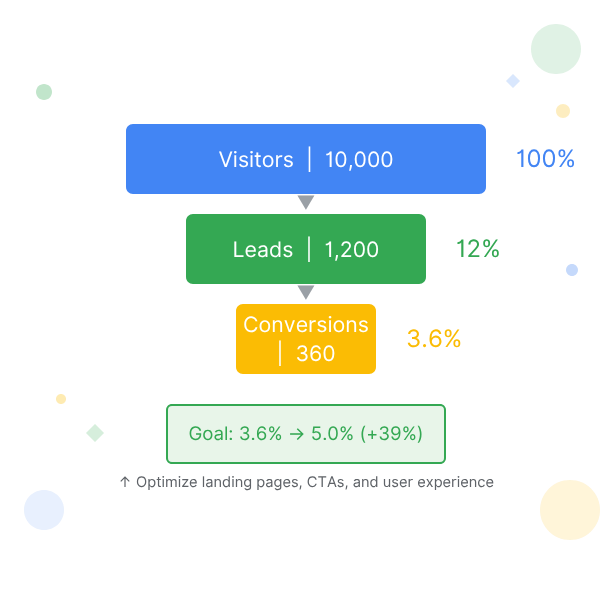
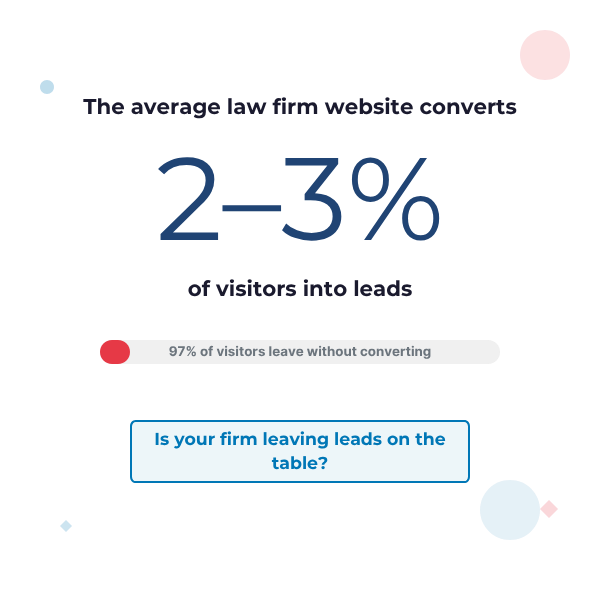
For every 100 people who land on your site, 97 leave without contacting you.
The solution isn't more ad spend. It's optimizing your page content and structure to improve conversions.
Because if the underlying problem isn't fixed, you're just pouring more water into a leaking bucket.
Conversion Rate Optimization (CRO) is how we fix the leak.
See what a conversion lift means for your firm
Current monthly revenue
$60,000
at 2% conversion
At 4% conversion
$120,000
+$60,000 / mo with same traffic
Our Conversion Rate Optimization Process
Here's what we look for:
First Impressions
Clear headers. Speedy pages. A great mobile experience. These are the three things that determine whether a visitor stays or leaves in under 5 seconds.
Messaging & Copy
Does your copy speak to what a distressed client is actually feeling? We audit every word for clarity, credibility and conversion intent.
Calls to Action (CTAs)
Are your CTAs buried? Are they too generic or, worse, too aggressive? We ensure your calls to action are visible and compelling, so it's easy for clients to take the next step.
Contact Forms
Are you turning off clients with lengthy contact forms? We test length, field order and copy to find the configuration that maximizes submissions.
Trust Signals
Social proof and trust signals help potential clients feel comfortable hiring your firm. We ensure your reviews, credentials, case results and bar memberships are immediately visible.
Mobile Experience
More than half of legal searches happen on mobile. If your site doesn't convert on a phone, you're losing the majority of your traffic.
Here's What Kills Conversion Rates
A phone number that isn't clickable on mobile
If a mobile visitor can't tap to call directly, most won't bother copying and dialing manually. We make sure your firm's line is just a tap away.
Slow page load on mobile
Every extra second of load time reduces conversions by roughly 7%. A 4-second load on mobile can cut your lead volume nearly in half before anyone even reads a word.
A headline that describes what you do instead of what you solve
"Personal Injury Attorney in Dallas" tells potential clients what you are. "Get the Compensation You Deserve — No Fee Unless We Win" tells them the problem you solve. One converts. One doesn't.
Generic social proof in the wrong place
A 5-star rating buried at the bottom of the page? Visitors will never see it. Specific, relevant reviews placed near your CTA? Those can lift conversion rates significantly.
How We Work
Audit
We review your site, analytics and user behavior to identify where visitors are dropping off.
Diagnose
We prioritize issues by impact and focus on the changes that will move the needle fastest.
Implement
We adjust your copy, layout, CTAs, forms and trust signals to boost conversions. We'll coordinate with your web team or handle it directly.
Measure
We track the results, report on conversion improvements and keep optimizing. CRO is a process, not a one-time fix.
Find out where your site is losing leads
We'll do a free conversion audit of your top landing page and show you the three highest-impact changes you could make right now.
FAQs
How long until we see results from CRO?
Some fixes, like a clickable phone number or a faster load time, produce results within days. Broader messaging and layout changes typically show measurable impact within 30–60 days as we accumulate enough traffic to draw conclusions.
Do we need a high-traffic site for CRO to work?
Not necessarily. Some optimizations don't require statistical testing. A missing click-to-call button is a problem regardless of traffic volume. That said, A/B testing is more reliable with higher traffic. We'll be upfront about what's testable vs. what we implement based on best practice.